What Makes a Colouring Book Truly Child-Friendly for Children with Dyslexia and Learning Differences?

Colouring books are often treated as the easy win of childhood: portable, quiet, creative, screen-free. Hand the child a page and some pencils, and the activity is supposed to take care of itself.
But for children who learn differently, the page design decides whether colouring feels inviting or exhausting.
This is why I am creating a dyslexia-friendly companion colouring book with Mudrik the Frog. The book is still in development and is planned for publication in a few months, but
I already know what I want children to feel when they open it: comfortable, curious and capable. I want the page to invite them in, not test them before they have even picked up a pencil.
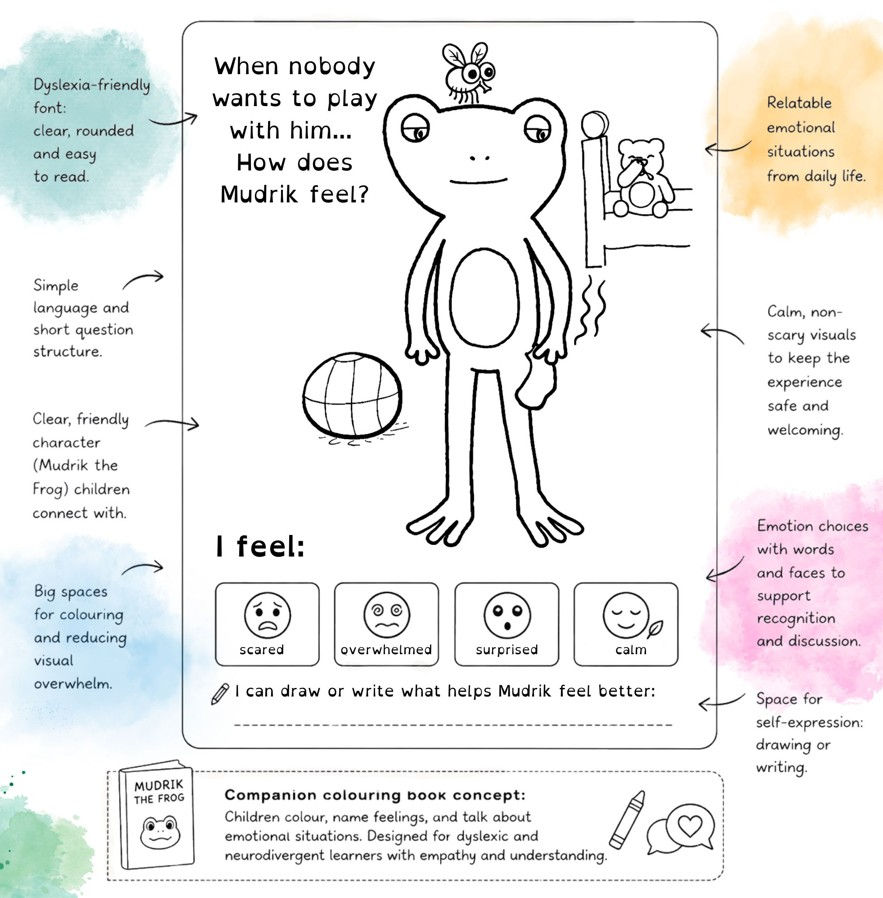
The structure looks simple on the surface: Mudrik appears in relatable everyday scenes, with emotions expressed that are likely to appear in those situations, and the child colours the page.
Underneath that simple activity is a richer process.
The child is invited to look at Mudrik’s face and body language, interpret what might be happening, recognise the emotion and articulate the feeling through a word, a face, a gesture, a drawing or a conversation.
Then they get to imagine what Mudrik might need next: a friend, a hug, a kind word, a game, a rest, or something entirely their own. That is where empathy and creativity begin to work together.
At first glance, colouring looks like one of the easiest activities we can offer children. It travels well. It fits into classrooms, cafés, waiting rooms, rainy afternoons, kitchen tables and holiday bags. It gives children something creative to do with their hands without needing a screen, batteries, Wi-Fi or an adult inventing a full theatre production before breakfast.
Still, a colouring page asks more from a child than adults sometimes realise.
The child has to understand the picture, process the prompt, recognise the emotion, choose a response, control the pencil, organise the page and sometimes produce written language as well. For a child with dyslexia, ADHD, autism, dyspraxia, dysgraphia or other learning difficulties, those layers can add up quickly.
This is why the design starts with the drawing.
In Mudrik’s colouring book, the illustrations use a simple hand-drawn style with clear outlines and large spaces for colouring. The first sketches were made by an eight-year-old child and then used as inspiration for the final illustrations. That shaped the visual direction of the book.
I wanted the pages to feel familiar, friendly and close to the way children actually draw, not like adult-made educational material pretending to be play.
Mudrik’s face and body language help children understand what he might be feeling, while the large colouring areas leave room for their hand to move. The page gives them space to add colours and ideas without needing perfect pencil control.
The text is kept short. One page might show Mudrik in a recognisable situation:
“When nobody wants to play with him… How does Mudrik feel?”
That is enough. The child has a character, a situation and one clear question. No paragraph to decode before the activity begins.
Dyslexia-friendly design is not solved by one font; spacing, contrast, layout, text size and the whole page experience all shape how readable and manageable a page feels.
That is why I am approaching the book as a full-page experience. The illustration, prompt, feeling choices and response space all need to work together.
On the sample page, Mudrik is shown in a situation children can understand. Under the question, the child sees feeling choices with simple faces and words: scared, overwhelmed, surprised, calm. This gives the child more than one route into the activity.
They can read the word, look at the face, point, circle, say the answer aloud, or discuss it with an adult.
This fits closely with Universal Design for Learning, which encourages different ways for children to access information and different ways to express what they know. In a colouring book, that can be wonderfully practical. A child can colour, point, speak, draw, write, choose a face, or invent a story around the character.
That flexibility is especially useful when writing appears inside activity books. Dyslexia is usually discussed through reading, but many dyslexic children also find spelling, handwriting and written expression demanding. If every colouring page ends with a compulsory written answer, the activity can easily become a worksheet wearing a frog costume. Charming, but still a worksheet.
So the prompt in this book says:]
“I can draw or write what helps Mudrik feel better.”
Some children will write one word. Some will draw a friend, a hug, a favourite toy, a football, a flower, a blanket, a pet, a snack or a biscuit so emotionally advanced it deserves its own sequel. Some will tell an adult their idea and ask them to write it down. Some will only colour the page and return to the feeling later.
All of those responses belong in the book.
The emotional side is part of the accessibility too. Young children are still building the language of feelings, and emotional literacy guidance highlights the value of helping children label emotions and build a feeling-word vocabulary. When children can name feelings, they have more tools for understanding themselves and communicating with others.
A character like Mudrik makes that process easier to approach. A child may not want to begin with “I feel left out.” But “Mudrik feels left out” gives them a safer first sentence.
The frog can go first.
From there, the adult can ask simple follow-up questions.
“What could help Mudrik?”
“Which face looks most like him?”
“Have you ever felt like that?”
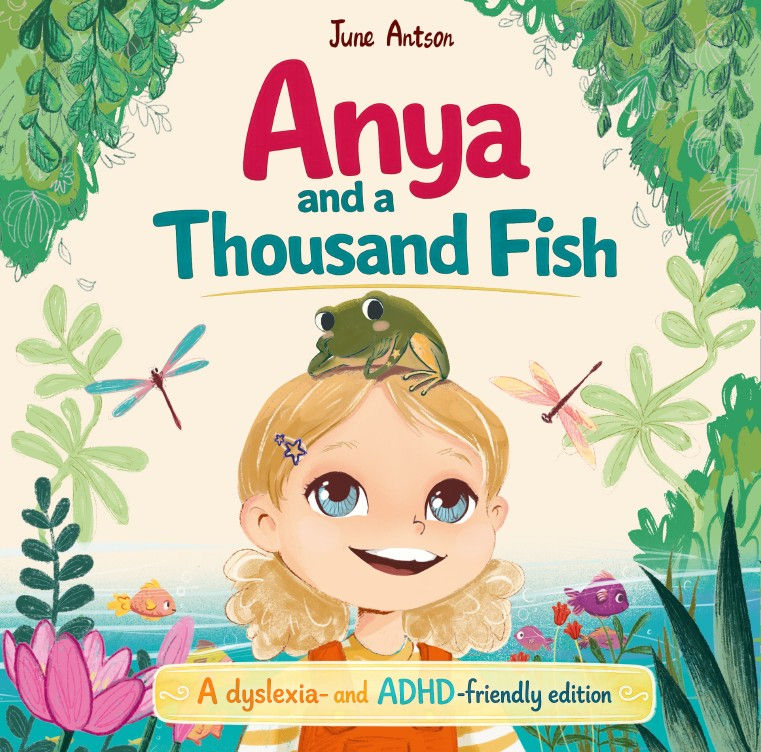
Mudrik gives these moments a clear, friendly shape. He is a frog with feelings, problems and funny expressions. He belongs to the world of Anya and Mudrik, where emotions are part of the story and children can meet them through image, language and play.
My hope is that a child opens the book and knows what to do.
Colour Mudrik.
Choose a feeling.
Draw an idea.
Say a word.
And somewhere between the pencil marks, the frog face and the feeling words, the child practises emotional language, creative expression and confidence on the page.
Sources used: International Dyslexia Association, CAST Universal Design for Learning Guidelines, Head Start emotional literacy guidance.


Comments