AI Literacy in Primary Schools: Why Children Are Learning to Question AI Earlier

AI literacy is starting to become part of what schools are expected to teach.
And in some countries, this is already happening with surprisingly young children.
Around the world, education systems are beginning to introduce artificial intelligence and AI literacy into primary and secondary education. The approaches differ, but several themes appear repeatedly: understanding what AI is, recognising its limitations, questioning AI-generated information, checking outputs and learning to use AI responsibly.
For younger children, this does not necessarily mean learning the technical details of large language models or algorithms. It can begin much more simply: learning that an answer produced by AI is not automatically a correct answer.
AI literacy is entering school curricula around the world
The UAE introduced AI as a formal subject in public schools in the 2025–26 academic year, from kindergarten through Grade 12. Its national AI literacy framework covers concepts such as how AI works, data and algorithms, ethics, real-world applications and responsible use. Ministry of Education
China is moving in the same direction. National guidance calls for AI education to become a regular part of primary and secondary education, beginning with awareness in the early primary years. In Beijing, every primary and secondary school began providing at least eight hours of general AI education per academic year from autumn 2025. For younger pupils, the emphasis is deliberately experiential rather than technical. Ministry of Education of China
Singapore is integrating AI literacy throughout the curriculum, co-curriculum and self-directed learning. Its updated Cyber Wellness lessons already teach children to validate information generated by AI and recognise deepfakes, while an expanded AI-focused Code for Fun programme is due across all schools in 2027. Singapore Ministry of Education
Australia now explicitly maps AI across its national curriculum from Foundation to Year 10. Its guidance says students should learn how AI works and understand its limitations and biases as their use of the technology increases. Australian Curriculum
Estonia launched AI Leap in September 2025, bringing AI tools and the skills required to use them into schools nationally. Estonian Ministry of Education and Research
AI literacy in primary schools in the Netherlands
Here in the Netherlands, the new digital-literacy curriculum goes considerably further than simply teaching children to use computers.
The proposed national primary-school learning goals explicitly include Artificial Intelligence under Kerndoel 22. These digital-literacy goals have been finalised by SLO, although they are still moving through the legislative process before becoming statutory nationwide. SLO
This places AI within a broader understanding of digital literacy: children need not only opportunities to use digital technologies, but also the knowledge and judgement required to understand and evaluate them.
What does UNESCO say about AI literacy for students?
The same direction is visible internationally.
UNESCO's AI Competency Framework for Students specifically calls for AI learning objectives to enter official school curricula. One of its central aims is critical judgement: children should understand AI well enough to question its outputs rather than simply accept them. UNESCO
This matters because AI literacy is not simply the ability to operate an AI tool. As children encounter generative AI more frequently, they also need to understand that AI can produce inaccurate, misleading or inappropriate information.
The ability to question an output is therefore becoming part of the ability to use AI.
What can AI literacy look like for six- and seven-year-olds?
This is exactly the problem I have been working on from the younger end of education.
My Look – Think – Ask approach gives young children three deliberately simple questions:
LOOK: What can I notice?
THINK: Does this make sense?
ASK: Who or what can help me check?
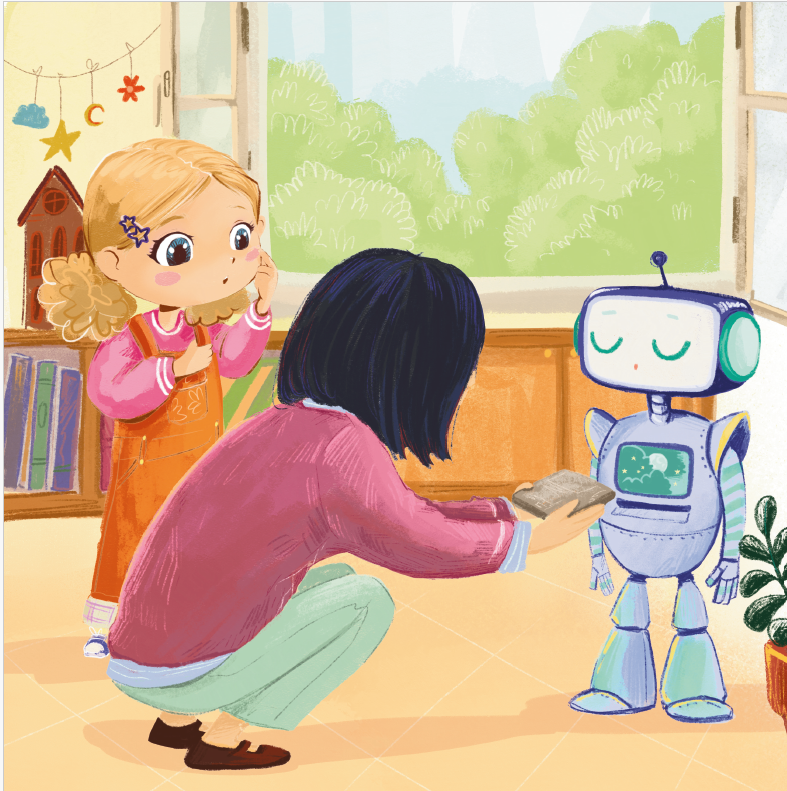
I developed the approach alongside my children's book Anya and the Robot Who Knew Everything, where a seemingly brilliant classroom robot starts giving answers that are not always right.
At six or seven, children don't need a lecture on large language models.
They can, however, start learning something that will follow them through every AI tool they encounter: an answer appearing confidently on a screen does not make it true.
That creates an accessible starting point for teaching critical thinking about AI to young children without expecting them to understand technology designed for adults.
Look – Think – Ask: a simple AI literacy approach for young children
The purpose of Look – Think – Ask is to give children a repeatable way to respond when they encounter information from AI.
Look encourages the child to pay attention to what the AI has actually produced.
Think introduces the habit of questioning whether the answer makes sense.
Ask reminds the child that checking can involve another source, another person or another way of finding out.
The framework is deliberately simple because the underlying habit matters more than technical terminology at this age.
That principle increasingly matches where school systems themselves are heading: understanding AI, questioning outputs, checking information and keeping judgement with the child rather than the machine.
UNESCO similarly places critical judgement, responsible use and a human-centred approach at the centre of student AI competency. UNESCO
Developing AI literacy materials for primary schools
I am now developing my work around AI literacy for younger children and exploring how the Look – Think – Ask approach can be used by schools and educators.
The aim is to make some of the principles appearing in national and international AI literacy frameworks understandable at the beginning of a child's relationship with AI: before technical knowledge becomes the focus and while habits around trust, questioning and checking are still developing.
You can see the programme and existing materials here:
If your school is working on AI literacy, digital literacy, critical thinking or responsible AI use with younger pupils and would like to discuss the materials or working together, contact me at contact@juneantson.com.


Comments