Reading, Writing and Emotional Intelligence: Why Access Shapes the Route for Children with Learning Difficulties

Research suggests that reading helps children develop emotional intelligence and emotional articulation by giving them words for feelings, repeated examples of motives and misunderstandings, and adult-supported opportunities to talk about what characters feel and why (Schapira and Grazzani, 2025; Dennis et al., 2024; Kogan, 2024).
For children with learning difficulties, this connection is especially important. If reading is slow, effortful or stressful, a child may have less comfortable access to one of the main everyday routes through which children practise naming emotions, understanding other people’s perspectives and explaining their own inner experience.
Emotional articulation begins with language.

A young child may first use broad words such as happy, sad, angry or scared. Over time, those words can become more precise: disappointed, frustrated, embarrassed, lonely, relieved, overwhelmed, proud. The richer the vocabulary, the easier it becomes for a child to explain what is happening inside.
That precision can change the adult-child interaction around a feeling. “I’m angry” begins the conversation. “I felt left out when they started the game before me” gives the adult more to respond to. The child can name the situation, the feeling and the need with greater accuracy.
For a child with dyslexia, developmental language disorder, ADHD or written-expression difficulty, this process may need more deliberate support.
The feeling may be fully present, while the language for it may be harder to reach under pressure. A child may know they feel bad and still struggle to find the difference between shame, worry, frustration or disappointment. Repeated exposure to emotional language through reading can help, especially when adults model the words clearly and return to them over time.
Stories support this development because they place feeling words inside events. A character wants something and loses it. A friend misunderstands. Someone hides a feeling. Someone says the wrong thing and repairs it later. Someone feels two things at once. These moments help children connect emotion words with causes, consequences, facial expressions, behaviour and relationships.
Schapira and Grazzani’s 2025 work on shared book reading in nursery and preschool settings found that books create a natural context for exploring characters’ feelings, practising emotion talk and building social-emotional competence. Dennis, Wade, Cole, Morsching and Haglund’s 2024 preschool research found that shared book reading improved children’s ability to identify and infer emotion vocabulary, even with a small sample. Kogan’s 2024 work on dialogic reading and direct instruction of emotion words reached a similar practical conclusion: repeated discussion of story characters helps children move from broad labels towards more specific expressions such as frustrated or grouchy.
For children with learning difficulties, shared reading can make the emotional content of a book reachable. A dyslexic child may understand a character’s emotional world more fully when an adult reads aloud and the child can focus on meaning instead of decoding.
A child with attention difficulties may benefit from shorter pauses, repeated prompts and a predictable rhythm. A child with language difficulties may need the adult to repeat the feeling word, link it to the picture, and use it again in another sentence.
Reading also develops perspective-taking. To understand a story, a child often has to hold several minds in view. One character knows something. Another character misunderstands. Someone intends kindness and causes hurt. Someone feels ashamed and covers it with anger. These are the same kinds of emotional puzzles children meet in friendship, family life and school.
Narrative reading gives children a structured way to practise that social reasoning.
Research on fiction and social cognition has found a small, statistically significant improvement in social-cognitive performance after fiction reading compared with nonfiction or no reading (Dodell-Feder and Tamir, 2018).
For children with learning difficulties, this story-based practice becomes more accessible when the reading format reduces load. Clearer pages, read-aloud support, shorter text sections and guided discussion help the child stay with the emotional meaning.
The relationship between language, literacy and emotional understanding also works as a feedback loop. Izard and colleagues showed that children’s emotion knowledge predicted later social behaviour and academic competence, even after accounting for verbal ability and temperament.
Emotion knowledge also helped explain the link between verbal ability and academic competence. In practical terms, language and literacy support emotional understanding, and emotional understanding supports learning, relationships and school adjustment.
This feedback loop is especially relevant for children with learning difficulties.
When reading becomes easier to access, the child gains more than literacy practice. They gain more chances to meet emotion words, follow social situations, discuss perspectives and build confidence in explaining inner experience. Stronger emotional understanding can then support participation, relationships and learning.
Writing supports emotional intelligence through a different route. Research on expressive writing suggests that written reflection can create psychological distance, helping children and adolescents organise experience, reflect and regulate. A feeling that was intense in the moment can become a sentence. A difficult event can become a written account with a beginning, middle and end. The child can return to the words, adjust them and understand the experience with more space around it.
For children who can access writing comfortably, journalling, story-writing, written reflection and written self-advocacy can become useful tools for emotional development.
Writing asks the child to put inner experience into language. That process can help a child move from a rush of feeling into a more organised account of what happened and why it affected them.
For children with written-expression difficulties, this benefit needs careful access support. If handwriting, spelling, grammar or sentence organisation take up most of the child’s energy, the emotional reflection may disappear behind the mechanics. Dictated writing, shared scribing, sentence starters, word banks, speech-to-text and shorter written responses can keep the focus on meaning. The written words remain central, and the route into them becomes more manageable.
Literacy support therefore becomes emotional support.
A child who repeatedly experiences reading and writing as exhausting may begin to associate literacy with exposure and failure. That emotional history can affect willingness to read, write, speak up or reflect. Research on dyslexia and broader learning difficulties points to higher risk in specific areas connected to emotional intelligence, including self-concept, emotion regulation, peer functioning and emotional expression (Polychroni et al., 2024).
Learning difficulties do not define a child’s empathy, depth or emotional capacity. They shape the route through which the child can access language-based emotional tools. A child may have rich emotional insight and still need support to read the story, write the sentence or retrieve the right word at the right time.
This is why reading practice, writing practice and emotional language should work together. A story can teach vocabulary, comprehension and feeling words in one routine. A written reflection can support sentence formation and self-understanding at the same time. A read-aloud session can build listening comprehension, perspective-taking and emotional articulation together.
For classrooms and homes, the most defensible strategies are practical and low-drama: read aloud without rushing; pause to name feelings; ask what a character wants, knows or misunderstands; offer a few possible emotion words; reread favourite books so vocabulary becomes familiar; use short written reflections with sentence starters; provide word banks for feeling words; allow dictated writing or speech-to-text when handwriting blocks expression; and keep the emotional aim visible inside the literacy task.
This approach keeps expectations rich and the route humane.
Children with learning difficulties deserve precise emotional language, meaningful stories and serious conversations.
Access-aware reading and writing practices help them reach the same depth through a route that respects their cognitive load.
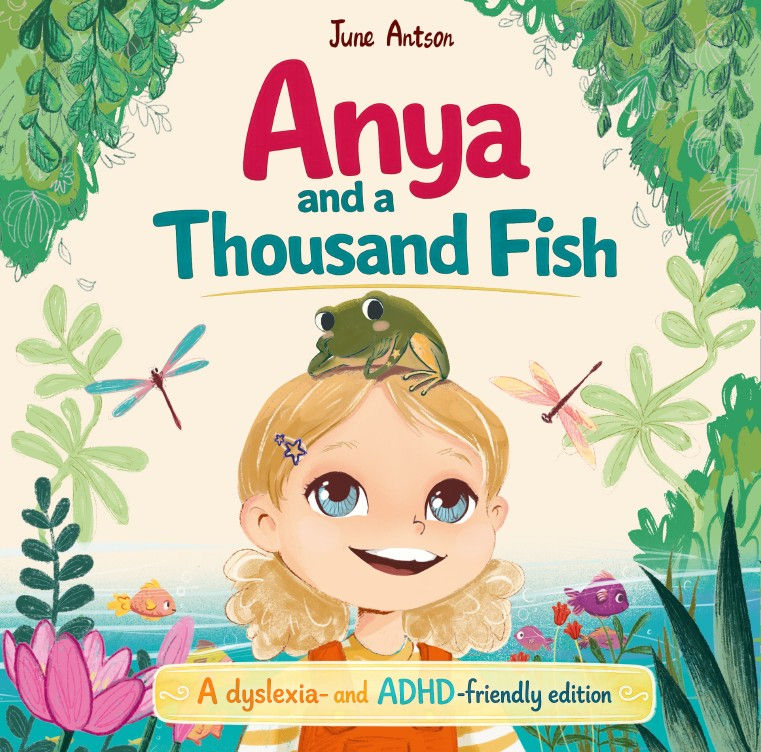
This is the thinking behind the dyslexia-friendly version of Anya and a Thousand Fish.
The dyslexia-friendly version brings reading access and emotional understanding together. Clearer presentation, calmer page flow and more accessible reading conditions help the child enter the book. The story world then supports feeling words, self-reflection, perspective-taking and conversation.
That combination can make the book a meaningful tool for children with learning difficulties. It supports access to reading and gives children language for thoughts, feelings, confusion, repair and self-understanding.
Children who struggle with reading and writing deserve the emotional benefits of books.
They deserve stories that meet them with beauty, clarity and respect.
When reading becomes accessible, the story can do its deeper work.


Comments