When Teachers Use AI to Write Feedback

Recent research shows that teacher use of generative AI is already widespread.
A 2025 Alan Turing Institute survey of 1,001 UK teachers found that 66% used generative AI in their work. Among those users, 71% were using it through a personal account rather than a school-provided licence. UK Department for Education research found that 44% of teachers used generative AI for school activities, including lesson planning, written feedback and marking. The National Literacy Trust also found teachers using AI for letters or emails to parents and student reports.
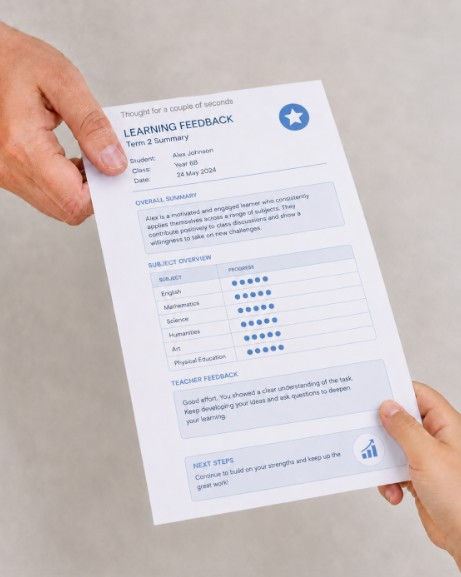
The most troubling shift is the movement of AI into feedback, reports and communication about children.
AI is useful for many teaching tasks. It can draft a worksheet, simplify a reading text, generate quiz questions, produce vocabulary exercises, organise lesson ideas or rephrase a message. These uses are already part of the working reality of schools. Teachers are under pressure, and AI reduces some of the manual labour around preparation and administration.
Feedback is different.
A comment on a child’s work is not only a response to an exercise.
It is also a record of the teacher’s attention. It shows whether the teacher has looked carefully, compared the work with what the child usually does, noticed the effort behind the result, and chosen the next step with that particular child in mind.
AI can produce a polished feedback comment very quickly. It can write something positive, identify an area for improvement, suggest a target, and end with encouragement. It saves time and gives the teacher something neat to paste into a document, learning platform or report.
However, something important gets lost in the process.
When a teacher writes feedback themselves, they are forced to spend time with the child’s work. Even a short comment requires attention. The teacher has to decide what the child has understood, what they have missed, whether the mistake is unusual, whether the work shows progress, and what response would be useful now. That effort is part of the educational relationship.
If AI starts producing the first draft too often, the teacher’s contact with the child’s actual work can become thinner. The teacher may still review the comment, but reviewing is not the same as forming the judgement from scratch.
A small distance opens up between the child’s effort and the adult’s response.
That distance is easy to underestimate.
Children do not only learn from corrections. They learn from being noticed. A specific comment tells a child, “My teacher saw what I tried to do.”
Over time, children can sense when feedback has become formulaic.
It may be grammatically perfect, professionally phrased and technically correct, yet still fail to create the sense that an adult has properly engaged with their work.
The same applies when feedback is written about a child for parents.
A school report or parent email is not simply a delivery system for information. It shapes trust. Parents read between the lines. They look for signs that the teacher understands their child, not as a general learner, but as a person with habits, moods, effort patterns, strengths, avoidances and small changes over time.
AI can help turn rough notes into clearer language, but it cannot replace the teacher’s personal investment in the observation itself.
If the teacher has not done the noticing, the writing may still sound polished, but the relationship becomes weaker.
Parents may receive a smooth paragraph that says all the expected things and still feel that no one has really seen their child.
When feedback is outsourced, even partially, schools risk weakening one of the social connections that holds education together: the relationship between teacher, child and parent.
The privacy issue makes this even more complicated.
Public surveys show how many teachers use AI and what they use it for, but they do not yet give strong national data on how often teachers enter identifiable student information into personal consumer AI accounts.
Still, the risk is serious enough that official guidance in several places warns schools not to enter student names, reports, assessment data, attendance information, personal histories or other sensitive details into public generative AI tools.
This creates a practical problem for feedback. Generic prompts produce generic comments. Specific prompts require context.
But the more context a teacher gives, the closer they may come to sharing personal information about a child.
A school-approved, protected system is very different from a teacher’s personal account.
But research shows that most teachers use generative AI through personal accounts...
Still, privacy is not the whole story.
AI can support the manual load around teaching: formatting, summarising notes, translating non-sensitive information, generating activity ideas, rephrasing clumsy drafts, reducing repetitive admin. But the judgement, observation and final wording of feedback should remain visibly owned by the teacher.
Schools need policies that say this plainly.
Teachers need to know which tools are approved, what information must never be entered, when AI can be used for drafting, and which tasks require direct human authorship.
Feedback, reports and parent communication should be treated as relational tasks, not just administrative ones.
AI may save teachers time. Used well, that time should return to children.
If AI gives teachers more space to observe, listen, respond and build trust, it has a place.
If it turns feedback into a polished shortcut, the cost will not show in weaker relationships, thinner trust, and children receiving words that sound personal without being personally earned.


Comments