When Survival Mode Looks Like Dyslexia

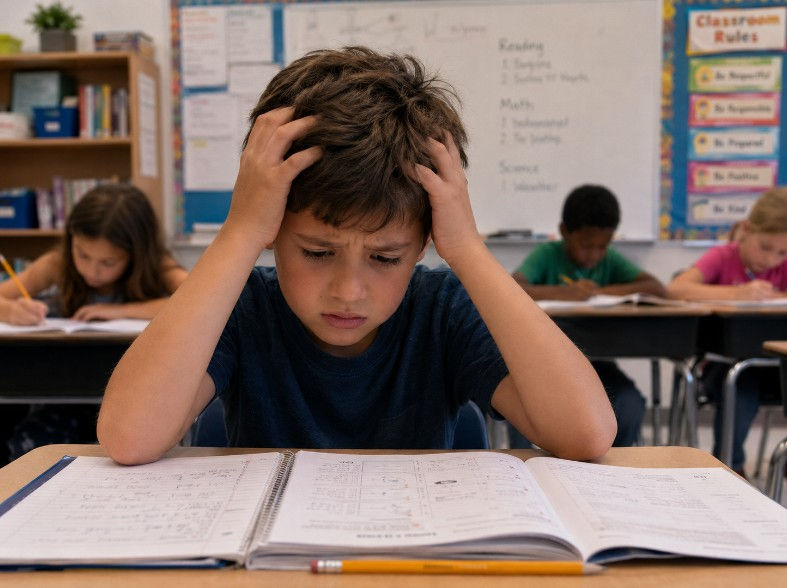
A child reads slowly, loses their place, guesses words, avoids reading aloud, forgets instructions, looks distracted, becomes anxious, or seems permanently behind.
From the outside, that pattern can look like dyslexia.
But sometimes the child is not showing the core signs of dyslexia itself.
They are showing what happens when attention, memory, language, confidence and emotional regulation have been disrupted by neglect, abuse, chronic stress, grief, family instability, traumatic change, or prolonged emotional insecurity.
That distinction matters.
Dyslexia is real and specific. It is not a vague label for any child who struggles with reading.
But dyslexia-like behaviour can also emerge when a child has spent too much time in survival mode. If the social and emotional forces around the child are not examined carefully, the child may receive the wrong label, the wrong support, and the wrong story about themselves.
Dyslexia has its own profile
Dyslexia is understood as a specific learning difficulty affecting accurate or fluent word reading and spelling.
The International Dyslexia Association describes dyslexia as involving difficulties in word reading and/or spelling, affecting accuracy, speed, or both, and persisting even when instruction is effective for the child’s peers. It also recognises that dyslexia develops through interacting genetic, neurobiological and environmental influences.
There is strong evidence for a genetic component. A large 2022 Nature Genetics study reported that family studies suggest heritability up to 70%, and identified 42 independent genetic loci associated with dyslexia. The same paper describes dyslexia as a complex, multifactorial trait, often involving impaired phonological processing.
Social impact can produce dyslexia-like learning difficulties
Reading is not just a technical act. It asks a child to coordinate attention, memory, language, sequencing, emotional safety, confidence, frustration tolerance and the ability to make mistakes without feeling threatened.
Chronic stress, caused by abuse, neglect or prolonged emotional insecurity, can keep a child’s body in a heightened state of alert.
Elevated stress responses, including higher levels of adrenaline and cortisol, can interfere with the attention, working memory, curiosity and emotional regulation that learning requires.
Neglect can add another layer: it may also leave gaps in the foundations reading grows from, such as stable conversation, shared reading, emotional co-regulation, routines, and adult support for language development.
In the classroom, these effects may look like distraction, freezing, avoidance, over-compliance, inconsistency, or difficulty staying with a reading task, not because the child is choosing not to learn, but because their nervous system and developmental foundations are not fully available for learning.
Attention is the confusing middle ground
Attention is one of the easiest places to misread the child because similar behaviours can come from different mechanisms.
A dyslexic child may avoid reading because decoding is genuinely slow and effortful, while a child affected by anxiety or trauma may avoid it because reading has become a performance threat.
Hypervigilance can pull attention away from the line of text, while dissociation may make a child look dreamy, detached or inattentive.
So behaviours such as avoiding reading aloud, forgetting what was just read, guessing words or losing place on the page should be treated as clues, not conclusions.
The useful question is not only, “What does the child do?”
It is, “Why might the child be doing it?”
The useful distinction is pattern, not presentation
Dyslexia tends to show a persistent word-level pattern.
The child has difficulty with accurate or fluent word reading and spelling. Decoding unfamiliar words is hard. Phonological processing may be weak. Reading remains slow and effortful even when the child is verbally capable, supported and motivated.
Socially shaped learning difficulties often have a wider and more variable pattern.
The child’s performance may shift sharply depending on safety, relationship, pressure, fatigue or emotional state, improving with a trusted adult and collapsing when the task feels exposing or intimidating.
Their difficulty may sit across attention, memory, emotional regulation, language, trust and self-protection, rather than mainly in the mechanics of decoding.
Misdiagnosis happens when one behaviour is treated as if it has only one possible meaning.
A child affected by neglect, abuse or chronic stress may be labelled dyslexic when the main driver is survival mode, not a word-level reading difficulty. Dyslexia in a child may also be missed when adults explain everything away with social impact.
So the question is not, “Is it dyslexia or trauma?” It is, “Which parts are dyslexia-specific, and which parts are shaped by the child’s social and emotional experience?”
Dyslexia has its own traits, patterns and biological basis, but not every child who looks dyslexic is dyslexic.
A child does not need the quickest explanation. They need the right one.


Comments