AI Did Not Break Homework. It Exposed It.
- June Antson
- Apr 28
- 3 min read

Agentic AI did not suddenly destroy homework.
It revealed how much of it has been built around outputs that can exist without visible thinking.
For a long time, completing homework meant arriving at an answer. Now, it often means producing one.
Agentic AI refers to systems that can generate full answers independently. Cognitive reps are repeated mental engagements that build understanding over time.
What this is not about
This is not an attack on structure, clarity, or polished work.
The issue begins when the process behind the answer disappears.
Once that happens, the result becomes ambiguous. You can no longer tell who understood, who partially grasped the idea, and who simply produced a convincing output.
AI in education made this so visible, which it originates in our educational system's traditions.
What actually changed
Homework was always searchable.
What changed is this:
Students no longer need to find answers. They can generate them instantly, in the expected form.
Most homework is still judged by coherence, completeness, and correctness. These still matter, but they are no longer reliable signals of student learning in an AI environment.
An answer can meet all three without the same level of thinking.
Not copied. Not imitated. Simply produced.
The missing piece: cognitive reps
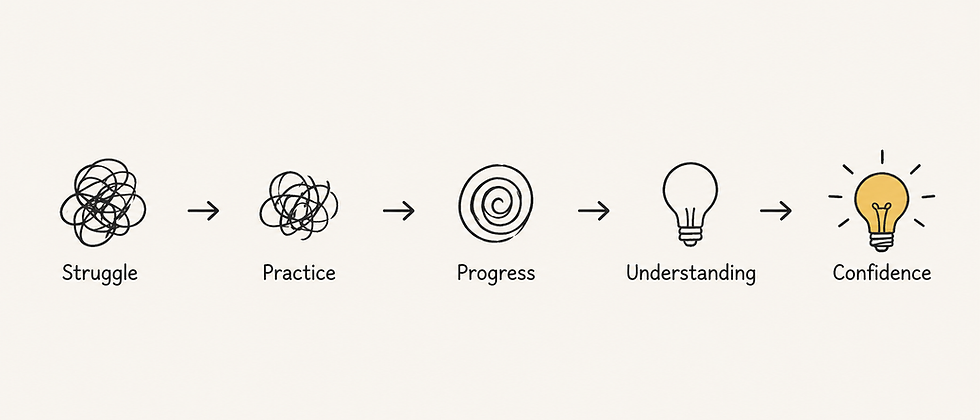
Learning builds through repetition, not empty repetition, but meaningful engagement with the same idea until it clicks.
Cognitive reps look like:
solving similar problems multiple times
writing and rewriting words to stabilise meaning and use
rephrasing ideas in different ways
revisiting concepts across contexts
refining earlier attempts
It can feel slow or inefficient.
But this is how the brain builds retention and flexibility. Repetition, when it is connected to meaning, strengthens pathways. It reduces effort over time by building familiarity, then confidence.
These reps are not a side effect of learning. They are the mechanism.
What AI removes
AI compresses the process:
Attempts, adjustments, rewording, second passes, much of this can be skipped.
The task gets completed while fewer cognitive reps happen.
It's not dishonesty, not even dependency; however, a reduction in the number of thinking cycles a learner moves through.
The measurement problem
Two students can submit equally strong answers, while one did the thinking and one skipped most of it.
Their learning process was not the same, yet the output looks the same!
We can no longer infer understanding from the final answer alone.
We Designed for Answers, Not Thinking
We are used to evaluating finished answers as education systems are built for efficiency:
quick to check
easy to compare
simple to standardise
Evidence of thinking does not fit this scheme.... It is slower, messier, and harder to score.
So tension arises when we say we value thinking, but we design educational systems for what is easiest to process, and that is not individual thinking.
Of course, there are exceptions:
In mathematics, students are asked to show their working, not just give the final number. The method matters, and partial credit often reflects sound reasoning.
In language learning, drafts and corrections are part of the process. What matters is how meaning is built, not just the final sentence.
In literature, interpretation can be individual. A well-supported personal reading is often valued as much as, or more than, a standard answer.
These already recognise that process carries information the final answer cannot.
Practical takeaway
To keep homework meaningful in an AI-rich environment, tasks should:
make thinking visible
include reflection on how answers were formed
reward reasoning, not just correctness
require interpretation or judgement
Agentic AI didn’t break homework.
It forced us to admit that we were grading answers instead of observing thinking.


Comments